We hope you try these 7 exercises to kick start your new Pilates for beginners at home fitness routine! If you are just starting your Pilates journey these seven exercises are the place to start! Ready to begin? Also included is a full classical mat Pilates workout free on YouTube! Get started with Pilates at home today!

7-pilates-exercises-for-beginners-starting-at-home-blog-by-pilatesbody-by-kayla

Pilates for Beginners: 7 Easy Exercises to Try at Home

Thinking about trying Pilates but not sure where to start? You’re in the right place! Pilates is a low-impact workout that helps build core strength, improve flexibility, and develop better body awareness. And the best part? You don’t need expensive equipment or a studio membership to get started.

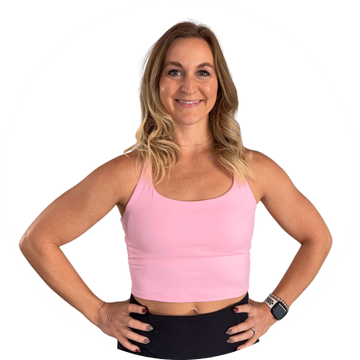
As a certified Pilates instructor with over 10 years of experience, I love showing people how accessible Pilates can be. Pilates for beginners doesn’t have to be complicated or intimidating. Learning a few foundational exercises and understanding proper form can make a big difference as you build strength and confidence.

In this guide, I’m sharing 7 Pilates exercises for beginners that you can do right at home. I’ll walk you through each movement with simple instructions and demonstrations so you can start practicing Pilates safely and confidently.

This post includes affiliate links. I do earn a commission for products purchased using these links (at no additional cost to you). Thank you for supporting PILATESBODY by Kayla, making the content you see on this blog possible.

Pilates Is for Every Body

When you hear the word Pilates, what are the first things that come to mind? Slow, easy exercises, or something only women do? I’ve even heard people say Pilates is for old people! But Pilates is so much more than the stereotypes. Even so, Pilates can feel intimidating at first.

When I first meet with clients at my in-home Pilates studio, I often hear them say, “I’m nervous!” And I get it. Some of the reformers and other Pilates equipment legit look like medieval torture devices!

But here’s what I want you to know. You don’t need a reformer, fancy equipment, or any Pilates experience to get started. Pilates for beginners is all about learning foundational movements, understanding how to engage your core, and building strength through controlled exercises.

Starting with mat Pilates at home is a great way to learn proper technique, improve body awareness, and build confidence before progressing to more challenging workouts. And trust me, those simple-looking exercises can be surprisingly challenging!

Not only that, but you can get the benefits of a reformer workout without the machine. Want proof? Check out my Reformer Inspired Pilates 3-Week At Home Challenge!

Classical-Mat-Pilates-Exercises-Full-Body-Flow-free-youtube-workout-by-pilatesbody-by-kayla-with-play-button

Prefer to Watch on YouTube?

You don’t need to attend a Pilates studio or gym to get started. With a little space and a comfortable mat, you can learn the foundational movements at home. All you need is the right gear to get started and a little know-how, and you’ll be ready to kick off your Pilates journey in your living room!

What Is Pilates and How Does It Work?

When you’re first getting started in Pilates, know that it can literally benefit any body. Trust that there are Pilates workouts and challenges out there designed exactly for what you need. If you’re more of a “hard core” athlete, there are many Pilates exercises that will level up your fitness program. If you love the intensity of HIIT, or running, Pilates will meet you on your recovery day. Because of its low-impact approach, it is designed to increase flexibility, strength, and balance.

Pilates at-home workouts can also be done every single day, especially if you are looking for consistency and advancement. Pilates for beginners starts off slower by focusing on the core, trunk, and pelvis to gain a better understanding of body mechanics and awareness. Pilates at home generally begins on a mat using your own body and sometimes small props like the Pilates ball, magic circle, and resistance bands. The beauty of Pilates is that it can be modified to fit the needs and abilities of all bodies and ages.

Before you start doing Pilates at home, you’ll want to know why you should do Pilates, the different types of Pilates you can do, and what you need to know before your first Pilates session.

Shoulder-Bridge-Exercise-Free-Beginner-Pilates-Core-Ab-Challenge-Pilates-Breathing-Basics-At-Home-On-Demand-PILATESBODY-by-Kayla

History of Pilates

Joseph Pilates is the creator of Pilates. Before the mind-body connective exercise received the name “Pilates,” he initially called it “Contrology,” with the idea that you have complete control of every movement within your own body.

Joseph was born in Germany and was said to be asthmatic and depressed. He studied a wide range of exercises, and Pilates ultimately became a form of physical rehabilitation for him. He focused on its low-impact style of movement that targeted muscles in a precise way while building total body strength. Joseph moved to New York City where he met his wife Clara, and they opened the first Pilates studio and taught together until his death.

Classical vs. Contemporary Pilates: What’s the Difference?

You may or may not know there are different types of Pilates. Although they stem from Joseph Pilates, their intentions are very different. It is important to understand the options and differences in how Pilates can be taught before beginning Pilates at home. The same Pilates exercises can be taught very differently from one type to the other. Just know that there isn’t a wrong way, but a logical way. And when beginners are starting Pilates, you’ll want to choose whichever type makes the most sense to you and feels right in your body and have basic knowledge of the differences between classical Pilates and contemporary Pilates.

Classical Pilates

Classical Pilates closely aligns from Joseph Pilates’ original method in that the exercises are taught in a sequential order with an imprinted spine or pelvis. This means the lower back is pressed into the mat during most exercises. I personally am classically trained and strongly believe in Joseph’s methodology to increase core strength and keep a healthy injury free body.

Contemporary Pilates

Contemporary Pilates is also based on the work of Joseph Pilates. However, many exercises have been modified and added in addition to the original order to take into account new Pilates research and theories. It is also generally practiced with a neutral spine, meaning the position the spine is in when a body is standing upright with healthy posture. This means the natural curve of the spine and a small space under the lower back will be present when lying down.

Can You Start Pilates At Home as a Beginner?

If you’re a Pilates beginner starting Pilates at home for the first time, it may be to your benefit to connect directly with the certified instructor of the virtual or on-demand class, course, challenge or program you are thinking of starting with to find out their style of teaching. It may also further benefit you to start off by doing a virtual Pilates at home private lesson with them first. However, if you just want to move your body in a way that feels good regardless of the technicalities of the type of Pilates, just trust yourself and your intuition.

If you’re unsure about anything, don’t be afraid to ask questions! Pilates teachers undergo intensive training and continue their education annually. Our job is to study bodies and teach you how to move with precision and control.

How to Get Started with Pilates At Home

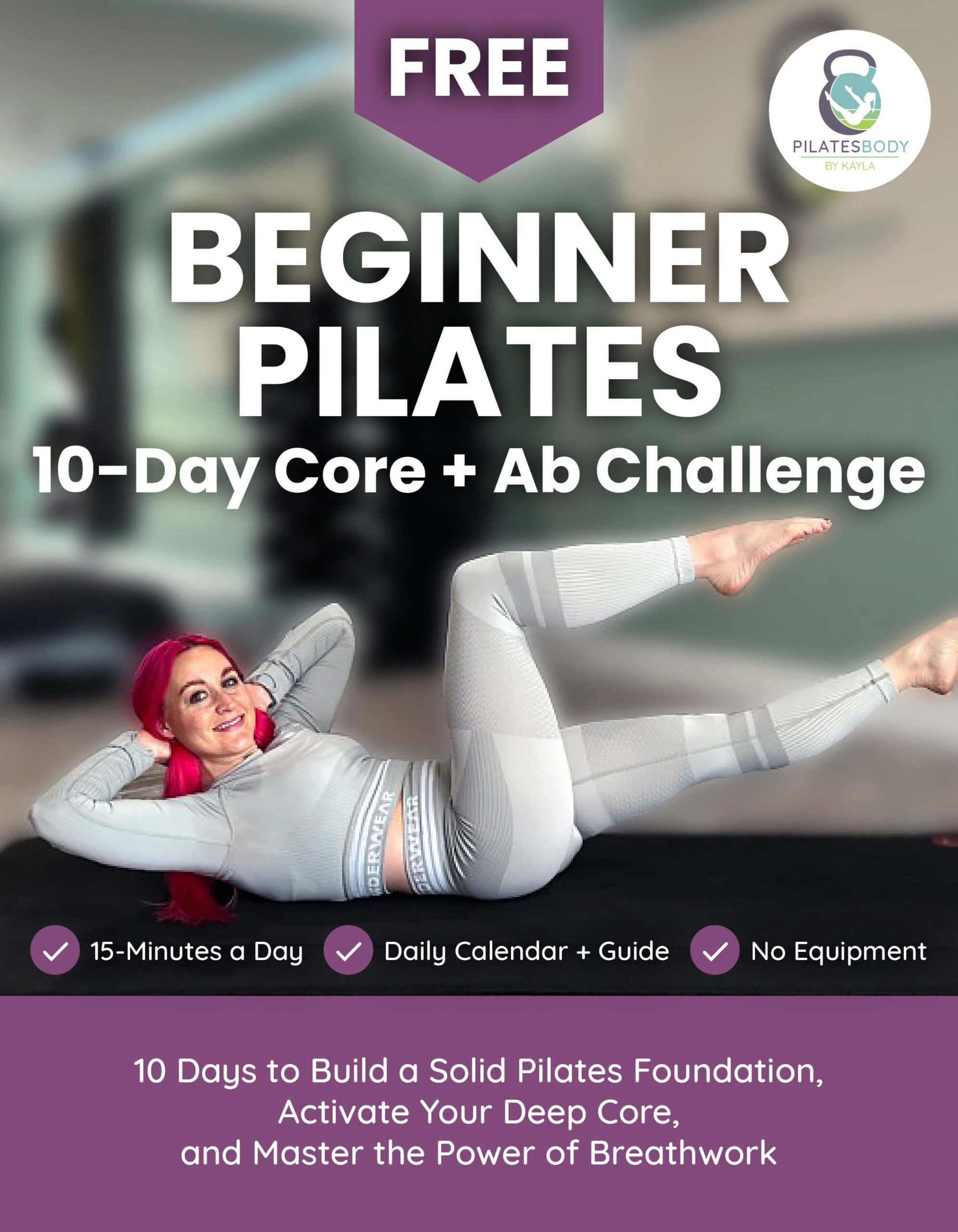
To get started with a Pilates at-home routine, you’ll want to find a qualified instructor that caters to beginners. These might be beginner-specific classes or a challenge or program designed for a Pilates beginner. Usually, a Pilates challenge will start with building a foundation, understanding the core muscles, and learning the principles of Pilates that will slowly progress with each workout. This is similar to how my Beginner Pilates 10 Day Core and Ab Challenge and 8 Week Core + Booty Challenge are set up.

Tips for Starting Pilates as a Beginner:

1. This Is Your Pilates Journey

You don’t need to be a certain kind of fit or flexible to do Pilates. As soon as you decide to start, you are ready. You’ll just need to decide if you want to get started with Pilates at home or in a studio. This could be determined based on budget, accessibility or injuries.

2. Do Your Research

Find articles similar to this one that demonstrate beginner Pilates exercises with descriptions, photographs, and video. Try them on your own before doing a fully guided class. Also, review my tips for keeping safe while doing Pilates.

3. Set Up a Pilates Space

You’ll want to have a space dedicated for Pilates at home. Make sure your floor is level; it can be on hardwood or carpet. You don’t need a ton of room, but enough to lay out your mat and have some space along the front, back and sides. You’ll also want to have room for some small pieces of equipment nearby.

4. Gather Equipment

While you can do a beginner Pilates workout without any equipment, I do recommend a few basic items. For example, a Pilates mat can make floor exercises more comfortable, and a Pilates ball can help you get the most out of core exercises. My top picks for beginners are linked later in the blog.

Shop My Pilates Mat

This Eco-friendly Pilates mat is made of high-density soft foam with a durable surface. It is easy to clean and easy to hang with its reinforced eyelets. Available in a variety of sizes and fun colors!

Pilates mat with strap

Shop My Pilates Mat

This Eco-friendly Pilates mat is made of high-density soft foam with a durable surface. It is easy to clean and easy to hang with its reinforced eyelets. Available in a variety of sizes and fun colors!

7 Pilates Exercises for Beginners to Try at Home

Beginner Pilates Workout Instructions

Follow along with Pilatesbody by Kayla YouTube, led by Certified Pilates Instructor, Kayla Brugger of PILATESBODY by Kayla.

Fitness Level: Beginner

Overview:

  • Breathing
  • Core activation and strengthening
  • Body alignment

1. The Hundred

Targets: Core strength, abdominal stamina, and stability

how-to-do-beginners-pilates-hundred-exercise-free-workout-on-youtube-by-pilatesbody-by-kayla

How to do the Pilates Hundred Exercise

  1. Begin by lying on your back, palms down and arms long by your sides.
  2. Bend your knees at a 90-degree angle keeping your knees over your hips.
  3. Exhale to lift your head and shoulders off the mat, feeling your abs contract. Your arms should be extended in front of you with your palms facing down.
  4. Inhale. Exhale and begin to pump your arms up and down.
  5. Breathe in for five seconds and out for five seconds, until you reach one hundred, while keeping your arms pumping.

*See a live demonstration of the Hundred Exercise.

*Read more about the Pilates Hundred.

2. Glute Bridge

Targets: Glutes and pelvis; reduces back pain

how-to-do-beginners-pilates-glute-bridge-exercise-free-workout-on-youtube-by-pilatesbody-by-kayla

How to Do the Glute Bridge Exercise

  1. Begin laying on your back, palms down and arms long by your sides.
  2. Begin with your knees bent and feet planted hip width apart, pressing heels firmly into the floor.
  3. Inhale. Exhale to raise hips up until you create a straight line from knees, hips to shoulders.
  4. Press arms back to goal post position by squeezing the shoulder blades and upper back muscles.
  5. Inhale lower hips down and return pelvis to the mat.

*See a live demonstration of the Glute Bridge Exercise.
*Read about the benefits of glute strengthening.

3. Pelvic Tilt

Targets: Pelvic mobility, low abs, spinal alignment; stretches lower back

how-to-do-beginners-pilates-pelvic-tilt-exercise-free-workout-on-youtube-ezgif.com-optimize-by-pilatesbody-by-kayla

How to Do the Pelvic Tilt Exercise

  1. Begin by lying on your back, palms down and arms long by your sides.
  2. Begin with your knees bent and feet planted hip-width apart, pressing heels firmly into the floor.
  3. Inhale. Exhale to tuck hips and move into a posterior pelvic tilt, lifting up through the front of the pelvis as if you’re drawing your pubic bone to your navel.
  4. Inhale and return pelvis to neutral position.

*See a live demonstration of the Pelvic Tilt Exercise.

4. Rolling Like a Ball

Targets: Spinal mobility and massage, core strength, breathing

how-to-do-beginners-rolling-like-a-ball-exercise-free-workout-on-youtube-ezgif.com-optimize-by-pilatesbody-by-kayla

How to Do the Rolling Like a Ball Exercise

  1. Sit on your mat and hug knees into your chest. Holding onto your shins, tuck your head down towards your knees. Pick up your feet and balance on your seat.
  2. Inhale, then exhale as you roll backwards, holding onto your shins tightly, until your shoulders touch the floor. (Avoid rolling onto your neck.)
  3. Then roll back up until you’re balancing on your bottom again.

*See a live demonstration of the Rolling like a Ball Exercise.

5. High Plank

Targets: Full body

How to Do the High Plank Exercise

  1. Begin on all fours with knees under hips and hands under shoulders.
  2. Inhale. Step your feet back to raise your hips up until your body is in a straight line from head to heel.
  3. Exhale, pressing hands and feet firmly into the mat and keeping your core engaged. Hold for as long as you can, while breathing deeply.

*See a live demonstration of the High Plank Exercise.

6. Spinal Balance

Targets: Spinal stability, lengthening, core strength, balance

How to Do the Spinal Balance Exercise

  1. Begin on all fours, knees under hips and hands under shoulders.
  2. Hold your belly button over the center of your mat, keeping your core engaged.
  3. Inhale. Begin raising one arm and the opposite leg. Hold for three seconds.
  4. Exhale. Lower down to all fours.
  5. Repeat with the opposite arm and leg.

*See a live demonstration of the Spinal Balance Exercise.

7. Swan Extension

Targets: Spinal extension, chest and abdominal stretch

how-to-do-beginners-pilates-swan-extension-exercise-free-workout-on-youtube-by-pilatesbody-by-kayla

How to Do the Swan Extension Exercise

  1. Begin by lying down on your belly with your elbows bent and palms underneath your shoulders.
  2. Engage the entire back of your body and zipping legs together.
  3. Inhale. Lengthen your neck and slowly begin to raise your forehead, nose, chin, and chest, lightly pressing into your palms while keeping your elbows tight against your ribs.
  4. Exhale. Lower back down.

*See a live demonstration of the Swan Extension Exercise.

Classical-Mat-Pilates-Exercises-Full-Body-Flow-free-youtube-workout-by-pilatesbody-by-kayla-with-play-button

Prefer to Watch on YouTube?

Pilates for Beginners FAQ

How often should a beginner do Pilates?

If you’re new to Pilates, I recommend starting with 2–3 sessions per week. This gives your body time to learn the movements, build core strength, and recover between workouts. Even 15–20 minutes can make a difference. As your strength and confidence improve, you can gradually increase the length or frequency of your Pilates workouts.

Can I do Pilates at home without equipment?

Yes! Mat Pilates is one of the easiest ways to start Pilates at home. All you need is a comfortable exercise mat and enough space to move. Many beginner Pilates exercises use your body weight to strengthen your core, improve flexibility, and build stability. As you progress, you can add equipment like a Pilates ball, resistance bands, or light dumbbells for an extra challenge.

Should Pilates complement another fitness routine?

Absolutely! In fact, I believe Pilates and strength training work even better together. Pilates helps improve core stability, mobility, balance, and body awareness, which can support better movement during strength training. Meanwhile, progressive strength training helps build muscle and increase overall strength.

That’s exactly why I created my 2+2 Pilates X Strength Method, which combines Pilates sculpt workouts with progressive strength training. If you love Pilates but want to build muscle, improve definition, and see more noticeable results, combining the two is a great place to start.

How are Pilates and yoga different?

Yoga is deeply rooted in its spiritual and meditative practice. There is a greater emphasis on breath and different types of breathing, along with a greater focus on stretching and relaxation.

Pilates, in relation to yoga, stems from the mind-body connection. In Pilates, there is more strength and dynamic movement involved, which may consist of isometric holds, body rehabilitation, and teaching the body to move from the core out. While both are very good for your body, as well as low-impact, they have very different components.

Best Pilates Equipment for Beginners at Home

Beginner-Friendly Equipment for Home Workouts – My Top Picks

One of my favorite things about Pilates is that you don’t need much equipment to get started. A comfortable mat and your body weight are enough for a great beginner workout. But as you build strength and confidence, adding a few simple Pilates accessories can help you challenge different muscle groups, improve stability, and keep your workouts interesting. Here are some of my favorite pieces of equipment for practicing Pilates at home.

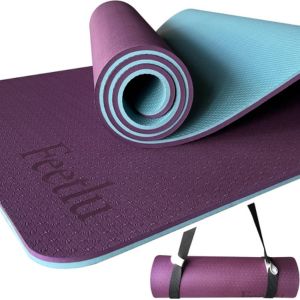
  1. Pilates Mat
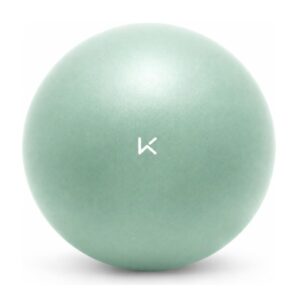
  2. Pilates Ball
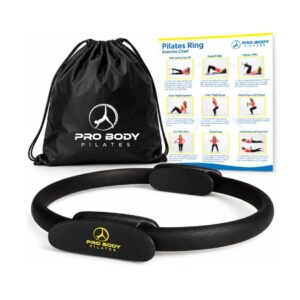
  3. Pilates Circle
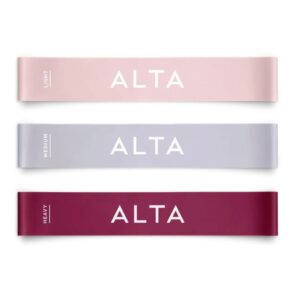
  4. Resistance Bands
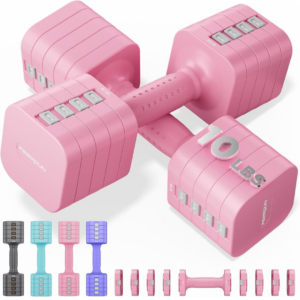
  5. Adjustable Dumbbells
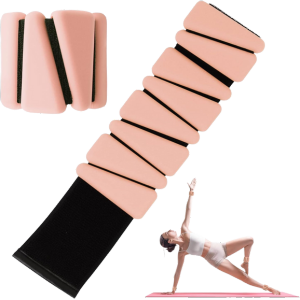
  6. Ankle Weights
  7. Gliding Sliders

A good Pilates mat is the foundation of your home workouts! I recommend a comfortable, cushioned mat that supports your spine, knees, and hips during floor exercises. It’s the one piece of equipment I’d prioritize for beginners.

A small Pilates ball is one of my favorite tools for deep core exercises, inner thigh activation, and improving stability. You can also use it to modify certain movements or add an extra challenge as you get stronger.

Also called a magic circle, this classic Pilates accessory adds gentle resistance to exercises targeting your inner thighs, arms, and core. It’s great for improving muscle engagement and control without using heavy weights.

Resistance bands are affordable, versatile, and perfect for Pilates at home. I love using them for glute activation, lower-body exercises, and adding resistance to familiar movements. Start with a lighter band and increase resistance as your strength improves.

If you want to combine Pilates with strength training, adjustable dumbbells are a great investment! They make it easy to increase resistance as you build muscle and get stronger, without needing an entire rack of weights at home.

Ankle weights can add a little extra resistance to your favorite Pilates leg and glute exercises. They’re especially useful for controlled, low-impact movements once you’ve mastered proper form using just your body weight.

Gliding sliders turn simple Pilates exercises into challenging, full-body movements! I love using them for core work, lunges, and controlled leg exercises. They challenge your stability and coordination without adding impact.

Classical-Mat-Pilates-Exercises-Full-Body-Flow-free-youtube-workout-by-pilatesbody-by-kayla-with-play-button

For a fully guided Beginner Pilates workout, check out my Classical Mat Pilates class, which goes through all of the Joseph Pilates movements including those above. Follow along with the workout on YouTube!

Ready to Start Pilates At Home?

Share your favorite exercise below in the comment section! If you haven’t tried any yet, I’d love to chat with you on how to start.

Your Friend & Pilates Expert,

signature-01

Kayla Brugger
Founder of PILATESBODY by Kayla
Founder of PILATESBODY On-Demand

Free Beginner Pilates 10-Day Core + Ab Challenge

10 days to build a solid Pilates foundation, activate your deep core, and master the power of breathwork with my Free Online Course Guide and Daily On-Demand Pilates Workout Videos

Free-Beginner-Pilates-10-Day-Core-and-Ab-Challenge

Free Beginner Pilates 10-Day Core + Ab Challenge

10 days to build a solid Pilates foundation, activate your deep core, and master the power of breathwork with my Free Online Course Guide and Daily On-Demand Pilates Workout Videos

Leave a Reply


Kayla Brugger, Pilates instructor and founder of PILATESBODY by Kayla

Hi, I'm Kayla Brugger. Certified Pilates Instructor & Minnesota Mama of 2.

More About Me

Pilates Programs

YouTube Workouts